Implementing a robust BIM strategy is crucial for any project’s success. AEC firms need clear, defined goals for a Common Data Environment (CDE), information exchange, and digital asset management to ensure data validity and interoperability for the overall lifecycle. BIM implementation reduces rework, enhances visualization, provides precise scheduling and cost estimation, increasing project efficiency.

Leading CAD Outsourcing Company offers solutions of Engineering CAD Services, Design Drafting & 3D Modeling
Email us:
info@truecadd.com
info@truecadd.com
Leading CAD Outsourcing Company offers solutions of Engineering CAD Services, Design Drafting & 3D Modeling
Top 5 Benefits of A BIM Implementation Strategy for AEC Firms
Updated on June 2nd, 2026
Table of Contents
BIM is one of the most powerful tools in the AEC industry. However, architects, engineers, and facilities managers often get overwhelmed while implementing it. Shifting the framework from 2D drawings to information rich 3D models, often requires a mental reboot in terms of adopting new software and workflows.
 Credits: thebusinessresearchcompany.com
AEC firms may often hesitate to adopt new technologies like BIM. This happens for several reasons such as resistance to change, initial costs of training and software and new direction towards workflows. The issue can also be related to data interoperability between multiple tools.
Implementing BIM correctly, helps visualization and collaboration. This article discusses the various advantages of implementing BIM including higher efficiency, error pullback and improvements in cost management with information ready insights.
Why BIM implementation is essential for AEC firms
When incorporated correctly, BIM implementation centralizes information, facilitates coordination, and improves decision-making.
In fact, BIM enables stakeholders as well as AEC companies to use 3D models for design, collaboration and high impact results. BIM implementation is a lot more than software adoption, it requires objectivity, proper training and a planned roll out.
Inability to deploy a transparent BIM strategy can take projects into a negative direction. In the absence of a well-defined BIM strategy, AEC firms deal with disconnected workflows and poor team coordination.
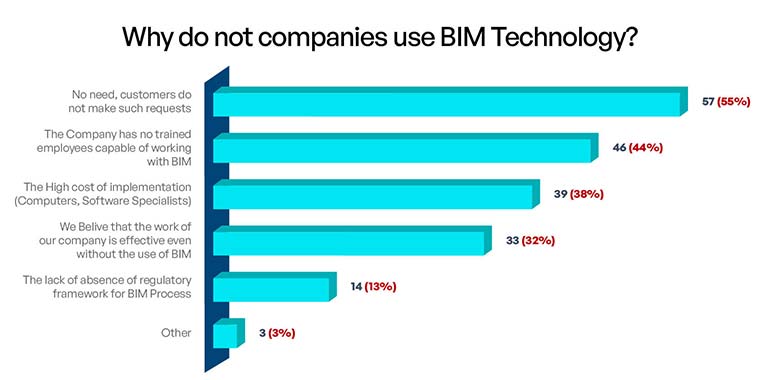
Lack of a proper BIM workflow, resistance to change, inadequate training, and lack of leadership are key reasons for BIM adoption to fail. Also, expectations that are unreal and inaccurate change management drives well planned BIM operations to struggle.
 Credits: mdpi.com
Top 5 benefits of BIM implementation for AEC firms
Efficient BIM use requires more than just building 3D BIM models in Revit, it requires regularized workflows and integrated processes. When these components work together, an AEC firm can experience quantifiable improvements in results. This section explores advantages that makes BIM a powerful disruptor.
Reduce rework through early clash detection
When a well-set BIM strategy is put forth, it facilitates multi trade model clash coordination in the preconstruction stage. This ensures a significant reduction in construction expenses and eliminates distortions in project timelines.
Clash detection is a key process in BIM implementation. In fact, it is one of the most prolific capabilities of BIM using tools like Revit and Navisworks. When individual 3D models are integrated into one federated model, there is a chance of conflicts due to misalignment between various components. The capability to detect multi-disciplinary clashes in a virtual environment results in reduced rework and ensures the project is constructible.
When RFIs, change orders and site rework are minimized, it ensures effective results. AEC firms can achieve this with thorough proper planning, transparent communication and detailed documentation.
Improve collaboration & workflow standardization
BIM adoption becomes seamless when you adopt global workflows and standards in a construction project. It helps your team collaborate faster and reduce disagreements.
A BIM Execution Plan or BEP is a key playbook that can help teams in AEC firms define certain roles and responsibilities. In addition, you can set project goals, standards and deliverables for every stakeholder involved in the project.
For AEC firms looking at organization and efficiency, it is important to set standardized naming for elements and files. Subsequently, when a clear LOD is defined, it clears many ambiguities to execute a project.
When a Common Data Environment (CDE) is used, it fosters interoperability at another level within your project. Moreover, formats like IFC and project specific protocols, ensure precise data flow, cut down errors and set high collaboration standards.
Enhance project visualization and decision making
When BIM is incorporated with a positive mindset, it provides a 3D environment that is dense in data, and enables informed decision-making. The decision making process becomes trustworthy and mitigates design uncertainties.
For example, a Revit 3D model is an effective deliverable that is visually clear for your project stakeholders to understand aesthetics and function. Hence, a unified understanding cuts disagreements and combines understanding.
 Credits: mdpi.com
When 2D drawings are converted into 3D models, they facilitate quick and detailed coordination. This process can flag clashes early and ensure better constructability by minimizing construction site issues and constant changes.
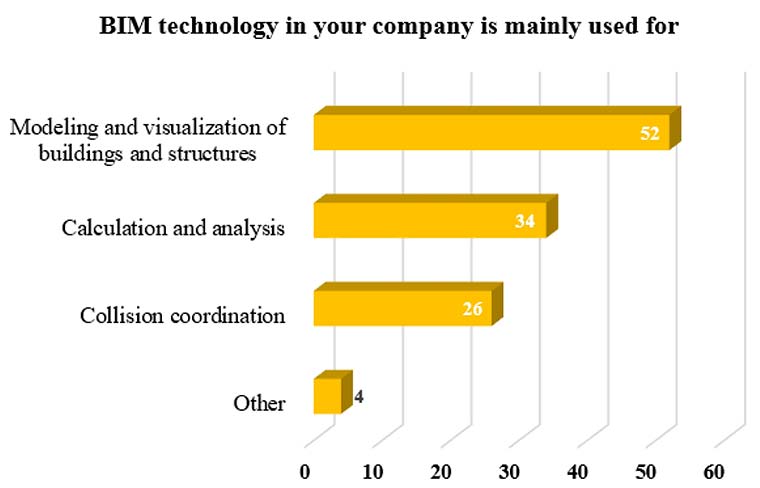
As per a study, 52% of participants said that BIM technology in their company was mainly used for modeling and visualization of buildings and structures.
By using BIM, the approval process becomes effortless. In addition, visualizations are intuitive and immersive that enable stakeholders to understand complex designs and accelerate schedules.
Streamline cost and schedules
AEC firms can use Revit 3D models to get precise schedules and cost data, and aim to reduce project costs and improve timelines. This gives the company greater control over project costs and delivery schedules.
A 3D model can be enriched with time to improve its value in Revit. Immersive and automated construction sequences reveal the order and timing of every activity on the site, while spatial conflicts are highlighted between planned tasks. This improves logistics and phasing.
By including cost data into Revit, firms can make their construction projects financially aware. Teams can extract quantity takeoffs directly from the 3D model as the design evolves, improving the groundwork for budget predictability.
In fact, if 4D and 5D data are combined during preconstruction, it can help stakeholders enable better analysis and create mitigation strategies to prevent risks.
Enable long term asset value
An AEC firm can extend the capabilities of BIM processes and tools beyond construction into operations and maintenance. It can foster long term project value along with higher owner satisfaction.
Facilities managers can leverage digitized data, which is regularized and includes product warranties, O & M manuals, and asset registers. When asset data is maintained properly, it ensures a quick transition and complete operational capacity.
With accurate Digital Twins, the final building conditions are accurately reflected for space management and simplified maintenance workflows. When accurate and data-rich assets are used within the 3D model in Revit, they can help you improve capital planning and overall cost of ownership.
Ready to streamline your design and construction process, but don’t know how?
Schedule a consultation »Coordinated 3D Revit model for a hospital building in Egypt
A leading healthcare construction company collaborated with TrueCADD, for a hospital project in Egypt. They provided PDF files as input and needed to create a 3D model.
The team of BIM specialists at TrueCADD used Revit to build a 3D model at LOD 300 following AIA standards. All the models were coordinated and clash tested. Quality checks were applied with matrices and checklists.
The 3D model helped:
- Carry out energy and performance analysis.
- Enhance design accuracy and efficiency.
- Realize construction cost savings of 30% to 35%.
 3D Architectural BIM Model for Eye Hospital
 BIM Model for eye Hospital Front Appearence
6 essential strategies to adopt BIM
Comprehending BIM’s significance is one thing, implementing it with a strong strategy matters the most. From defining clear objectives, delegating roles and responsibilities, developing a BEP to selecting the right BIM tools and training teams with the required skills, all are crucial for a project’s success.
The following essential strategies will help stakeholders easily adopt and implement BIM in their companies.
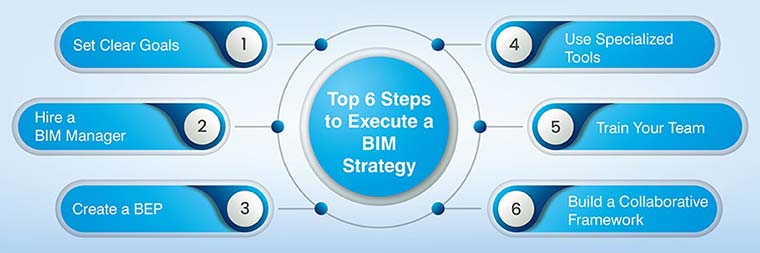
- Define clear objectives: The first step involves defining clear goals. It is crucial to establish unique and quantifiable project goals to achieve project success.
- Appoint a BIM champion: The second step involves the proper delegation of roles and responsibilities so that there is greater clarity. It is important to designate various professionals to different tasks for proper BIM implementation.
- Develop a BIM Execution Plan (BEP): The third and important strategy is to build a comprehensive plan that outlines the processes. Creating a BIM execution plan keeps all the stakeholders on the same page and brings in greater project clarity.
- Select the right BIM tools: With technology advancements, it is also important to choose the right kind of software and tools. Selecting and using tools like Revit and Navisworks with built-in BIM capabilities prove to be extremely beneficial for construction projects.
- Train Teams and Build BIM Skills: It becomes equally important to make sure the in-house staff receives adequate training to use the tools and technology.
- Establish Collaboration Protocols: The last but not the least step includes improving communication within teams. For this, it is important to define collaboration steps for teams or use platforms like BIM 360, so that all the stakeholders are on the same page.
Wrapping up
When teams implement BIM using Revit and Navisworks, it helps them build projects with higher efficiency. When both are integrated for future projects, they will ensure collaboration improvements, automated project management, and higher sustainability.
Combining data analytics and cloud computing will help AEC firm with automated and smart decision making. If BIM is adopted with skill enhancement, it will support stakeholders to stay competitive in a data led industry. BIM will set the foundation of sustainable and effective project handovers.
Make your projects BIM ready with cutting-edge solutions.
Connect with our team»









Harika Singh
Harika Singh is a published author with over 20 years of experience working with leading organizations in India and the United States. She develops authoritative content on BIM, CAD, VDC, digital engineering, and construction technology. Her expertise lies in translating complex technical concepts into actionable insights that help AEC professionals improve collaboration, efficiency, and project outcomes.
Related Posts
Need help on an ongoing basis?
We establish long term business relationships with clients and are committed to total customer satisfaction.
Home |
Sitemap |
Privacy Policy | Data Security & Confidentiality |
Contact us |